You pull out of a parking spot, turn the wheel, and hear a steady click, click, click from the front of the car. It goes away when you straighten out, then comes back on the next sharp turn. So, why does my car click when turning? In most front-wheel-drive and all-wheel-drive cars, a worn outer CV joint is the culprit. That isn’t the only possibility. Let’s break down each cause and show you how to narrow it down.
Why Does My Car Click When Turning? 6 Common Causes
A clicking noise during turns almost always comes from a part that moves or flexes as the wheels steer. Some causes are cheap fixes, while others affect your steering and shouldn’t wait. Here are the six most common culprits, starting with the one mechanics see most often.
Worn Outer CV Joint
Constant velocity (CV) joints sit at each end of the front drive axles and let the wheels steer while still receiving power. Each one is packed with grease and sealed inside a rubber boot. Over time, that boot can crack or tear. Grease slings out, dirt and water get in, and the joint starts to wear. The result is the classic rhythmic clicking during tight, low-speed turns, like in parking lots or at intersections. The click usually speeds up as you accelerate through the turn and gets louder. If it clicks only in one direction, that’s a useful clue to the worn side.
Worn Strut Mount or Strut Bearing
On cars with MacPherson strut suspension, the top of each front strut sits in a mount with a bearing that lets it rotate as you steer. When that bearing dries out or wears, you may hear a click, pop, or creak when you turn the wheel, even when parked. It’s often fixed while replacing shocks and struts, since the mount comes off anyway.
Bad Ball Joints
Ball joints connect the control arms to the steering knuckles. A worn ball joint tends to make more of a clunk or creak than a sharp click, especially over bumps while turning. A ball joint that separates can cause the wheel to collapse outward, so it needs quick attention.
Loose or Worn Tie Rod Ends
Tie rods link the steering rack to the wheels. Excess play in a tie rod end can produce a clicking or knocking sound and may also make the steering feel vague or wander on the highway.
Worn Sway Bar Links and Bushings
Worn stabilizer bar end links often click or rattle as the body leans in a turn. The fix is cheap, DIY-friendly, and our guide on how to replace sway bar links walks through the job.
Loose Brake Hardware or a Failing Wheel Bearing
A loose caliper bolt, missing anti-rattle clip, or a pad shifting in its bracket can click when the car changes direction. A wheel bearing usually hums or growls rather than clicks, but a badly worn one can tick in turns. If you also hear a hum that rises with speed, check the signs in how to tell if a wheel bearing is bad.

How to Find Where the Clicking Is Coming From
You can narrow things down in about 15 minutes with no special tools. Start with these four checks.
- Do the parking lot circle test. In an empty lot, turn the wheel fully and drive slowly in a circle, then repeat the other way. A loud, steady click that matches wheel speed points strongly to a CV joint.
- Turn the wheel while parked. With the engine running, turn the steering wheel lock to lock. A click or pop from the top of the fender suggests a strut mount, since the axle isn’t spinning.
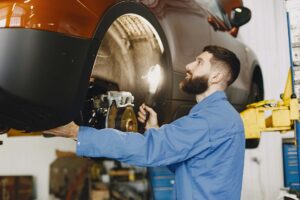
- Look at the CV boots. Turn the wheels fully to one side and check behind the front tire with a flashlight. A torn boot, or grease sprayed around the wheel well, means the joint has been exposed. RepairPal notes that technicians start the same way.
- Check for play. With the front of the car safely on jack stands, rock the tire at the top and bottom. Movement there suggests a ball joint or wheel bearing, while play at the left and right sides points to a tie rod end.
Is It Safe to Drive With a Clicking Noise?
Usually yes for a short time, but don’t put it off. A clicking CV joint rarely fails overnight, but when it does, it can leave you stranded or cause a loss of control at speed. Worn ball joints and tie rods are more urgent because they affect steering. If the clicking turns into clunking or vibration under acceleration, get the car inspected right away.
Catching a torn boot early is the cheapest outcome. Once the joint is clicking, it’s already worn, so a new boot alone won’t fix it. RepairPal recommends new axle assemblies over rebuilt units and says replacing only the boots offers little advantage.
How Much Does It Cost to Fix?
These are RepairPal national averages, updated September 2026, including parts and labor but not taxes or fees.
| Repair | Average cost | Notes |
|---|---|---|
| CV axle replacement | $1,283 to $1,381 | Labor $208 to $306; price varies a lot by model and part brand |
| CV boot replacement | $411 to $528 | Only worth it before the joint starts clicking |
| Strut bearing replacement | $398 to $552 | Toyota Camry $416 to $560; Honda Accord $356 to $513 |
| U-joint replacement | $331 to $406 | Applies to rear-wheel-drive trucks and SUVs |
Ball joint and tie rod prices vary widely by vehicle, and both usually need a wheel alignment afterward. If you’re comfortable with tools, a CV axle swap is a common DIY job, but it still pays to find a good mechanic for anything involving steering or ball joints.

How to Prevent Clicking Noises
Most of these parts wear out eventually, but a few habits can stretch their life:
- Check the CV boots at every oil change. A torn boot caught early can be replaced before the joint is damaged.
- Avoid hard launches at full steering lock. Accelerating hard while turned sharply puts the most stress on CV joints.
- Slow down for potholes and curbs. Impacts are hard on ball joints, tie rods, and strut mounts.
- Get an alignment after suspension work. It keeps steering parts loaded evenly and protects your tires.
Don’t Ignore the Click
A click when turning is your car’s early warning. Most of the time, it’s a CV joint you can replace on your own schedule, but it can also point to steering parts that need attention sooner. Run the quick checks above, confirm the source, and book the repair before a small noise becomes a bigger bill.
Frequently Asked Questions About Clicking Noises When Turning
Can a CV Joint Click When Going Straight?
Rarely. A worn outer joint usually stays quiet in a straight line. A worn inner joint is more likely to cause vibration or a clunk when accelerating, and if the car shakes as you speed up, our guide on why your car shakes while driving covers the other causes.
Can Low Power Steering Fluid Cause Clicking?
It more often causes whining or groaning, but air in the system can create odd noises while steering. Topping it up is quick, and you can follow our steps on how to change power steering fluid.
How Long Can I Drive With a Clicking CV Joint?
There’s no safe fixed number. Some last thousands of miles, others fail quickly. Book a repair as soon as you confirm the cause.