
If you’ve ever watched a fully loaded semi roll past you on the interstate and wondered how those tires handle the weight, you’re not alone. Commercial truck tires are among the most engineered components in the transportation industry, and for good reason. They’re the only part of a 40-ton vehicle actually touching the road. Getting them right means the difference between reliable, cost-effective freight movement and expensive blowouts, unexpected downtime, and serious safety incidents.
Whether you manage a fleet of eighteen-wheelers, operate a vocational truck for construction, or are simply curious about how commercial tire systems work, this guide breaks down everything that matters, from how to read and select the right tire spec to how top fleets are using technology to squeeze maximum life out of every set.
Why Commercial Truck Tires Are Nothing Like Passenger Tires
The average passenger car tire carries between 1,000 and 1,500 pounds per tire. A commercial truck tire in a drive or trailer position can carry upward of 6,000 pounds, and steer tires handle that load while also translating every steering input into directional control at highway speed. The engineering demands are on a different scale entirely.
Commercial truck tires are built with much thicker sidewalls, multi-ply steel-belted construction, and rubber compounds designed to handle sustained heat from continuous high-load operation. They also come in distinct designs for specific axle positions, steer, drive, and trailer, because each position experiences different stress patterns.
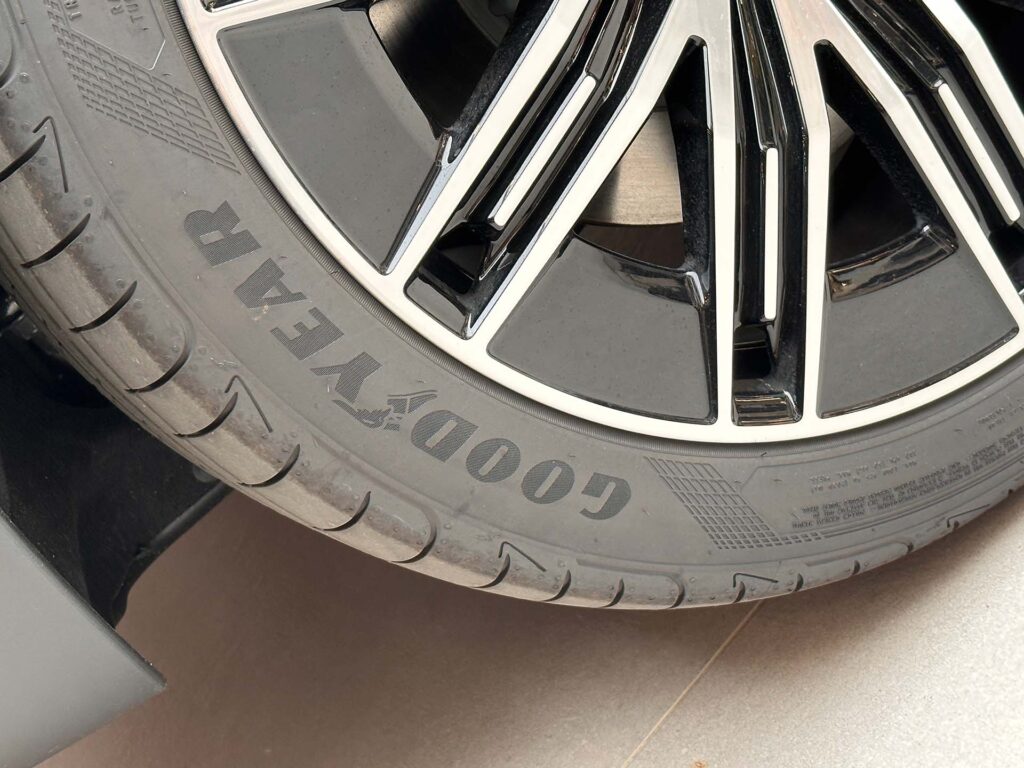
Before you can make any informed decision about commercial truck tires, you need to be fluent in how tire sizing and ratings work. The numbers on a commercial tire sidewall carry critical information about load capacity, speed rating, and fitment. If you haven’t already, our guide on how to read tire size walks through the full sidewall code in plain language, and while it uses a passenger tire as the example, the same decoding logic applies to commercial sizes like 295/75R22.5, one of the most common fitments in the Class 8 trucking world.
Understanding Commercial Tire Positions and Why They Matter
One of the most common and costly mistakes in commercial tire management is treating all axle positions as interchangeable. They aren’t.
Steer tires must deliver precise handling, resist irregular wear from constant directional loading, and maintain predictable traction in wet conditions. They typically have rib-pattern tread designs optimized for straight-line tracking. Putting a worn or mismatched tire on a steer axle is a safety issue, full stop.
Drive tires take the most abuse, they transmit the engine’s torque to the road surface while carrying enormous weight through acceleration and braking. They need aggressive lug-pattern tread with strong siping for traction, combined with heat-resistant compounds that hold up through thousands of miles of sustained operation.
Trailer tires primarily handle load-bearing with minimal torque transfer. They’re optimized for even wear under weight and are often candidates for retreading, the most cost-effective way to extend a commercial tire’s service life without sacrificing safety when done properly.
Running the wrong tire type in a given position accelerates wear dramatically and can introduce handling instability. Always verify that your spec matches the axle position.
The Cost Reality: What Commercial Tires Actually Cost Fleets
For most over-the-road fleets, tires are the second or third largest operating expense after fuel and driver wages. A single Class 8 truck runs 18 tires. At current market pricing for quality line-haul tires, a full set for one truck can run $7,000 to $10,000, and that’s before mounting, balancing, and any wheel service work.
Multiply that across a 50-truck fleet and you’re looking at tire spend that can approach half a million dollars per replacement cycle. This is why serious fleet operators don’t buy tires, they manage tire programs.
A structured tire program typically includes:
- Standardized tire specs by vehicle type and application to simplify inventory and ensure correct fitment across the fleet
- Retreading programs for drive and trailer positions, reducing per-tire cost by 30–50% compared to new while maintaining comparable performance when retreads are produced to quality standards
- Tracking cost-per-mile rather than purchase price, which reveals the true economic value of a higher-quality tire that outlasts a cheaper alternative
- Tire pressure monitoring integrated into the fleet’s maintenance workflow, since chronic underinflation is the single biggest driver of premature commercial tire failure
Tire Pressure: The Variable That Controls Everything Else
No single maintenance practice has a bigger impact on commercial tire performance than maintaining proper inflation. Underinflation generates excess heat, the primary enemy of tire longevity, by increasing sidewall flexion with every rotation. Running a commercial tire at just 20% below its rated inflation pressure can reduce its service life by as much as 30%, and the fuel economy penalty compounds across every mile driven in that condition.
Overinflation is also problematic: it creates a smaller contact patch, increasing center-tread wear and reducing wet-weather traction.
Modern fleets are increasingly deploying Tire Pressure Monitoring Systems (TPMS) that report real-time pressure and temperature data from every wheel position to the fleet management dashboard. When a tire begins losing pressure gradually, whether from a slow leak, a damaged valve stem, or a developing puncture, the system flags it before it becomes a blowout. That’s not just a cost-saving measure; on a steer axle at highway speed, it’s a life-saving one.
This kind of real-time monitoring capability is part of the broader shift in commercial vehicle management toward connected, data-driven operations. We explored that trend in detail in our piece on how predictive maintenance technology is reshaping heavy-duty fleet management, and tire monitoring is often the first place fleets see a measurable return on their telematics investment.
Irregular Wear: Reading What Your Tires Are Telling You
Commercial tires wear. That’s unavoidable. But the pattern of that wear is a diagnostic tool, and experienced fleet technicians learn to read it the way a doctor reads a chart.
- Center wear on a drive or steer tire typically indicates chronic overinflation
- Shoulder wear on both edges points to underinflation
- One-sided shoulder wear usually signals an alignment problem, camber or toe that’s pulling the load to one edge of the contact patch
- Cupping or scalloping, an uneven, wavy pattern across the tread, often indicates worn shock absorbers or suspension bushings allowing the tire to bounce rather than maintain consistent road contact
- Heel-toe wear on drive tires is common and can indicate that tire rotation intervals are too long or that the tread compound isn’t ideal for the application
Catching these patterns early and addressing the underlying cause, alignment, suspension wear, inflation management, extends the life of the replacement set and prevents the same problem from repeating.
Building a Smarter Commercial Tire Program
Effective tire programs don’t happen by accident, they’re built on solid operational standards covering everything from spec selection and inflation protocols to retread policies and end-of-life casing tracking. For fleets looking to formalize or benchmark their approach, the definitive industry resource on this subject is Commercial Truck Tire Management, which covers the full lifecycle of commercial tires from procurement through retreading, with practical guidance applicable to fleets of any size.
What the Dashboard Tells You About Tire Health
Modern commercial trucks are increasingly equipped with sophisticated instrument cluster displays that go well beyond the basics of speed and fuel. TPMS readouts, axle load indicators, and driver alert systems for tire events are becoming standard features on new vocational and line-haul trucks. Understanding how to read and interpret dashboard warnings is as important as the tires themselves.
The evolution of vehicle instrumentation, from simple analog gauges to fully integrated digital monitoring systems, mirrors the broader shift toward data-driven vehicle management. For a look at how dashboard technology has evolved across the automotive spectrum, our post on the best gauge clusters for your vehicle provides useful context on how much information modern vehicles surface to the driver.
The Bottom Line on Commercial Truck Tires
Commercial tire management is not a set-it-and-forget-it discipline. It’s an active, data-informed process that touches safety, fuel economy, uptime, and operating cost simultaneously. Fleets that treat tires as a consumable to be replaced when they fail are leaving significant money and safety margin on the table.
The fundamentals are straightforward: right tire for the right position, correct inflation maintained consistently, wear patterns monitored and acted on, retreads used strategically to extend casing value, and pressure monitoring integrated into the fleet’s broader maintenance workflow.
Get those right, and commercial tires stop being one of your biggest costs and start being one of your most controllable ones.